
Subtitle: A Technical Analysis for Optimal Material Selection
Date: October 16, 2025
Author: NW Fabric Technical Team
1.0 Executive Summary
Meltblown nonwoven fabrics are the cornerstone of high-performance filtration applications, most notably in respiratory protection (e.g., N95 masks), HVAC filters, and medical supplies. While the critical role of meltblown media is widely recognized, the specific impact of its two fundamental properties—Basis Weight and Fiber Web Structure—on filtration performance is often misunderstood.
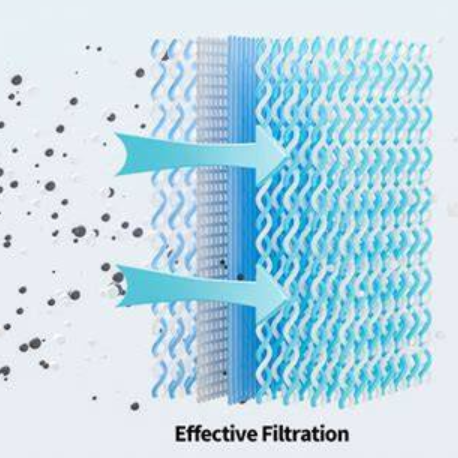
This white paper from NW Fabric provides a detailed technical analysis demonstrating how the careful calibration of these parameters directly controls filtration efficiency and breathability (pressure drop). Understanding this relationship is essential for manufacturers to optimize their product performance, ensure regulatory compliance, and achieve cost-effectiveness.
2.0 Introduction to Meltblown Technology
Meltblown is a specialized manufacturing process where polymer granules (most commonly polypropylene) are extruded through a die and immediately blown by high-velocity hot air to create a web of ultra-fine fibers. These microfibers, with diameters typically in the micrometer range, are randomly laid onto a collecting screen. The resulting fabric is characterized by:
- A complex, porous network.
- High surface area.
- Excellent barrier properties.
The primary filtration mechanisms in meltblown fabrics are:
- Interception: Particles following an airstream line collide with a fiber.
- Inertial Impaction: Larger, heavier particles cannot follow the curving airstream around a fiber and collide with it.
- Diffusion: Sub-micron particles bounce around randomly (Brownian motion) and collide with fibers.
3.0 Key Parameter 1: Basis Weight (Grammage)
3.1 Definition: Basis weight is the mass per unit area of the fabric, typically expressed in grams per square meter (gsm). It is a direct measure of the mass of fibers in a given area.
3.2 The Impact on Filtration Efficiency:
- Direct Correlation: Generally, increasing the basis weight directly increases filtration efficiency. A heavier fabric contains more fibers, creating a denser and more complex network for particles to navigate. This increases the probability of particle capture through the mechanisms described above.
- The Law of Diminishing Returns: The relationship is not purely linear. Initial increases in gsm yield significant gains in efficiency. However, beyond a certain point, adding more material provides progressively smaller improvements in efficiency while significantly increasing production costs and pressure drop.
Figure 1: Conceptual Graph showing the relationship between Basis Weight and Filtration Efficiency
(A graph showing a curve that rises steeply at first and then flattens out as basis weight increases.)
3.3 NW Fabric Insight:
At NW Fabric, we engineer meltblown fabrics with optimized basis weights for target applications. For instance:
- ~25 gsm: Suitable for general-purpose particulate filtration.
- ~40-50 gsm: Standard for high-efficiency applications like N95 respirators.
- ~80+ gsm: Used for demanding industrial or HEPA-grade filtration.
Table 1: Impact of Basis Weight on Filtration Performance (Constant Fiber Structure)
This table demonstrates the typical performance trend when increasing basis weight while maintaining a consistent fine-fiber web structure.
| Basis Weight (gsm) | Most Penetrating Particle Size (MPPS) | Filtration Efficiency (%) at MPPS | Pressure Drop (Pa) | Primary Filtration Mechanism |
|---|---|---|---|---|
| 25 gsm | 0.3 – 0.5 µm | 95 – 98% | 45 – 65 Pa | Interception, Diffusion |
| 40 gsm | 0.2 – 0.4 µm | 99.0 – 99.5% | 80 – 110 Pa | Diffusion, Interception |
| 55 gsm | 0.1 – 0.3 µm | 99.7 – 99.9% | 130 – 170 Pa | Diffusion |
| 80 gsm | < 0.1 µm | > 99.97% | 220 – 280 Pa | Diffusion |
NW Fabric Insight: The data above illustrates the efficiency/breathability trade-off. While 80 gsm media offers HEPA-grade efficiency, its high pressure drop may be unsuitable for respiratory applications. Our 40-55 gsm fabrics are engineered to hit the sweet spot for N95/KN95 equivalents.
4.0 Key Parameter 2: Fiber Web Structure
4.1 Definition: This refers to the physical architecture of the nonwoven web, including fiber diameter distribution, fiber orientation, and web uniformity (homogeneity).
4.2 The Impact on Filtration Efficiency:
- Fiber Diameter: This is arguably the most critical structural factor.
- Finer Fibers: Create smaller pores and a larger surface area within the same volume, dramatically enhancing filtration efficiency, especially for sub-micron particles via diffusion.
- Fiber Diameter Distribution: A tight, consistent distribution is key to predictable and uniform performance. NW Fabric’s advanced process controls ensure minimal variation in fiber size.
- Fiber Orientation:
- Random Orientation: A truly random laydown creates a tortuous, maze-like path for air, maximizing particle capture opportunities. This is the desired structure for most filtration media.
- Web Uniformity:
- Homogeneity: A consistent, defect-free web is non-negotiable for high-grade filtration. Any thin spots or “pinholes” act as shortcuts for unfiltered air, catastrophically compromising the entire filter’s efficiency. NW Fabric’s state-of-the-art production lines and rigorous Quality Control (QC) ensure superior web uniformity.
*Figure 2: Schematic comparing a uniform web (high efficiency) vs. a non-uniform web (low efficiency)*
(Two diagrams side-by-side. One shows a consistent mat of fibers. The other shows a mat with thin spots and clumps.)
Table 2: Influence of Fiber Diameter and Web Structure on Performance (Constant Basis Weight ~40 gsm)
This table highlights how advanced process control at NW Fabric optimizes structure for superior performance.
| Fiber Web Structure | Avg. Fiber Diameter (µm) | Filtration Efficiency (%) at 0.3 µm | Pressure Drop (Pa) | Quality Factor (QF) (kPa⁻¹) |
|---|---|---|---|---|
| Standard Meltblown | ~3.0 µm | 98.5% | 105 Pa | 12.8 |
| NW Fabric – Fine Fiber | ~1.5 – 2.0 µm | 99.4% | 95 Pa | 17.9 |
| NW Fabric – Bimodal* | Mix of ~1.5 & 5.0 µm | 99.6% | 85 Pa | 20.5 |
*Bimodal structures use a mix of fine and coarse fibers to create a more open, low-resistance web while maintaining high efficiency through enhanced depth loading.
NW Fabric Insight: As shown, our fine fiber and bimodal structures achieve higher efficiency at a lower pressure drop than standard meltblown, resulting in a significantly higher Quality Factor. This means better performance and greater comfort for the end-user.
5.0 The Critical Balance: Filtration Efficiency vs. Pressure Drop (Breathability)
This is the fundamental engineering trade-off in filter design.
- Filtration Efficiency: The ability to capture particles.
- Pressure Drop (ΔP): The resistance to airflow. A lower pressure drop means better breathability and lower energy consumption for fan-driven systems.
How Basis Weight and Structure Influence the Balance:
- Increasing Basis Weight alone increases both efficiency and pressure drop, often disproportionately.
- Optimizing Fiber Web Structure (e.g., using finer, randomly laid fibers) is the key to achieving high efficiency at a lower pressure drop. A fabric with fine fibers can achieve the same efficiency as a heavier fabric with coarse fibers, but with significantly better breathability.
*Figure 3: The “Quality Factor” Curve – Demonstrating the optimal combination of high efficiency and low pressure drop.*
(A graph with Filtration Efficiency on the Y-axis and Pressure Drop on the X-axis. A curve shows that the optimal materials achieve high efficiency with minimal pressure drop.)
The Quality Factor (QF) is a common metric to quantify this balance: *QF = -ln(1-Efficiency) / ΔP*. A higher QF indicates a superior filter material.
6.0 Case Study: NW Fabric in Action
Challenge: A client manufacturing N95 respirators needed to consistently meet the NIOSH requirement of ≥95% filtration efficiency at 0.3 µm while keeping pressure drop low enough for user comfort. They struggled with batch-to-batch consistency from their previous supplier.
Solution: NW Fabric provided our Water electret meltblown, characterized by:
- Basis Weight: 45 gsm (± 2 gsm)
- Target Fiber Diameter: 1.8 – 2.2 µm
- Key Feature: Exceptional web uniformity via advanced process control.
Result:
- Consistent Filtration Efficiency: 99.2% ± 0.3% (exceeding the N95 threshold with a safety margin).
- Low Pressure Drop: 85 Pa ± 10 Pa (ensuring good breathability).
- Improved Yield: The client’s final product rejection rate dropped significantly due to our material’s consistency.
7.0 Conclusion and NW Fabric’s Value Proposition
The performance of meltblown filtration media is not determined by a single parameter but by the sophisticated interplay of basis weight and fiber web structure. Selecting the right combination is critical for meeting specific application requirements, from medical masks to industrial air filters.
Why Partner with NW Fabric?
- Precision Engineering: We don’t just produce meltblown fabric; we engineer it. Our advanced process control allows us to fine-tune fiber diameter and web structure for maximum performance.
- Application-Optimized Solutions: We work with our clients to determine the ideal basis weight and structural properties for their specific needs, ensuring cost-effectiveness without compromising on performance.
- Uncompromising Quality: Our rigorous in-line and off-line QC systems guarantee the batch-to-batch consistency and uniformity that high-stakes filtration applications demand.
- Technical Expertise: Our team is ready to collaborate with you on your next product development challenge, leveraging our deep material science knowledge.
7.0 Call to Action
Ready to optimize your filter media?
Contact the NW Fabric technical team today for a consultation and request free samples tailored to your target performance specifications.
Email: [email protected]
Website: https://www.nwfabric.com
Disclaimer: This white paper is for informational purposes. Performance data is typical and should be validated for specific applications. All trademarks and logos are the property of their respective owners.