
In disposable face masks, the nose wire—often called a nose clip or nose strip—is a small yet critical component for performance. A well-designed nose wire ensures a secure facial fit, reduces air leakage, and improves wearer comfort.
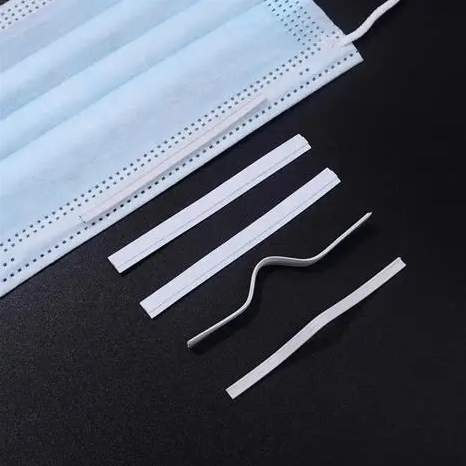
For manufacturers, selecting the right nose wire involves balancing cost, seal performance, user comfort, production compatibility, and market demands. This guide provides a clear, industry-focused overview of nose wires for disposable masks.
What Is a Nose Wire in a Disposable Mask?
A nose wire is a flexible strip embedded along the top edge of a face mask. It can be shaped by hand to conform to the bridge of the nose, creating a tighter and more stable seal.
Key Functions:
- Improves facial fit around the nose
- Reduces air leakage and prevents glasses from fogging
- Enhances filtration efficiency by minimizing gaps
- Increases comfort during extended wear
Common Types of Nose Wires
1. Plastic-Coated Metal Nose Wire Most Widely Used
The industry standard for medical and protective disposable masks.
Structure: Galvanized iron or stainless steel core with PE/PP plastic coating.
Advantages: Excellent shape retention, low rebound, smooth surface, cost-effective for mass production.
Applications: Medical surgical masks, KN95/KF94/FFP2 masks, general disposable masks.
2. All-Plastic Nose Wire (Metal-Free)
Made entirely from plastics such as PP, PE, or modified compounds.
Advantages: Metal-free, suitable for environments with metal detectors.
Limitations: Weaker shape memory, higher rebound.
Applications: Food processing, electronics manufacturing, metal-free workplaces.
3. Aluminum Nose Wire
Uses a flat or thin strip of aluminum.
Advantages: Strong shape retention, firm sealing.
Limitations: Higher cost, harder feel, reduced long-wear comfort.
Applications: High-end protective masks, industrial respirators.
4. Paper or Composite Nose Wires
Niche, eco-friendly options with limited use.
Characteristics: Lightweight, recyclable, but lower durability and shaping stability.
Standard Specifications
While customizable, the following ranges are common in the industry:
| Parameter | Common Range |
|---|---|
| Length | 80–100 mm (90 mm typical) |
| Width | 3–5 mm |
| Thickness | 0.4–0.6 mm |
| Color | White / Transparent |
| Supply Form | Roll or pre-cut strips |
How Nose Wires Are Fixed in Masks
In industrial production, nose wires are typically embedded using:
- Ultrasonic welding (most common, stable, and suited for high-speed machines)
- Heat sealing
- Adhesive bonding (less common)
Selection Factors for Manufacturers
When choosing a nose wire, consider these critical factors:
Maintains form after bending with minimal springback
Smooth coating that doesn’t damage non-woven fabrics
Works seamlessly with automatic mask production lines
Essential for export to humid climates
Uniform thickness, width, and length for reliable production
Meets relevant medical and safety standards
Regulatory & Quality Considerations
Nose wires influence compliance with major standards including:
- EN 14683 (EU medical masks)
- ASTM F2100 (US medical masks)
- KN95 / KF94 / FFP2 standards
Key quality expectations include:
- No sharp edges or protruding wires
- No chemical odor
- Resistance to rust and material degradation
- Safe for prolonged skin contact
- Consistent performance across production batches
Conclusion
Though small, the nose wire is a critical functional component in disposable face masks. Selecting the right nose wire enhances product performance, comfort, and market competitiveness.
Understanding materials, structures, and performance characteristics enables informed decisions—whether producing medical masks, protective respirators, or specialty masks for global markets.
For manufacturers seeking reliable nose wire solutions, partnering with experienced suppliers who understand both production requirements and international standards is essential for success in today’s competitive mask market.