
📑 Table of Contents
Landscape fabric is one of the most misunderstood tools in gardening and hardscaping. Walk into any home improvement store, and you’ll be faced with rolls of woven and non-woven fabric—often with little guidance on which one to choose. The truth is, picking the wrong one can turn a simple project into a costly headache.
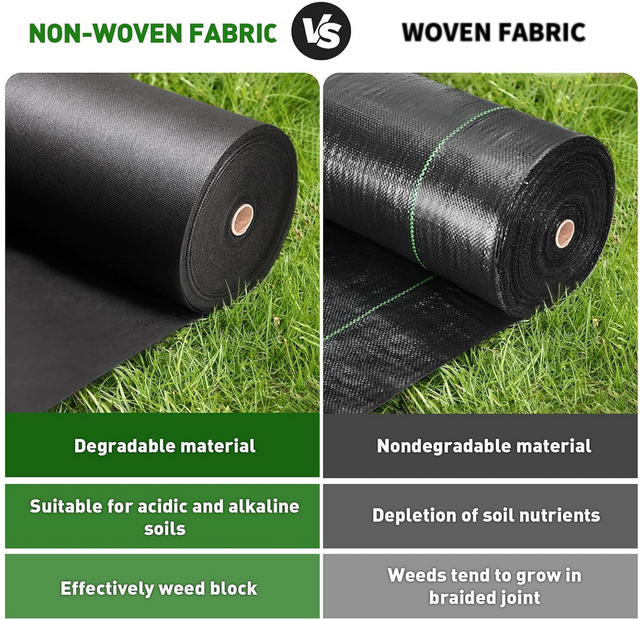
This guide breaks down everything you need to know about woven vs non-woven landscape fabric, with specific recommendations for weed control, gardens, French drains, retaining walls, and driveways.
What Is Landscape Fabric?
Landscape fabric (also called garden fabric, weed fabric, or landscape cloth) is a permeable textile laid on soil to block weed growth while allowing air and water to reach plant roots. It’s used everywhere from flower beds to gravel driveways, but not all fabrics are created equal.
The two main types—woven and non-woven—are manufactured differently, which gives them completely different strengths and weaknesses.
Woven Landscape Fabric: The Heavy Lifter
Woven landscape fabric is made by weaving polypropylene tapes or synthetic strands together in a crisscross pattern. Think of it like a durable, tightly woven tarp.
Key characteristics:
- High tensile strength: Excellent for load-bearing and reinforcement
- UV-resistant: Holds up well in direct sunlight
- Long lifespan: Typically lasts 5–10+ years when properly installed
- Lower permeability: Allows water through, but at a slower rate than non-woven
- Weed suppression: Blocks over 98% of light, preventing weed germination
Best uses: Driveways, gravel paths, under rocks, around trees and shrubs, long-term weed control
Non-Woven Landscape Fabric: The Drainage Expert
Non-woven landscape fabric is made by bonding synthetic fibers (polyester or polypropylene) together using heat, chemicals, or needle-punching. The result is a felt-like material with a random fiber structure.
Key characteristics:
- High permeability: Excellent water flow—up to 100 gallons per minute
- Flexible: Conforms to irregular surfaces easily
- Lighter weight: Often more affordable and easier to cut
- Moderate durability: Less robust than woven fabrics
- Excellent filtration: Keeps soil particles in place while letting water pass
Best uses: French drains, retaining wall drainage, filtration, erosion control, under pavers
Woven vs Non-Woven: Side-by-Side Comparison
| Feature | Woven Fabric | Non-Woven Fabric |
|---|---|---|
| Manufacturing | Woven strands in crisscross pattern | Bonded/needle-punched fibers |
| Texture | Smooth, fabric-like | Felt-like, fuzzy |
| Tensile Strength | High | Moderate |
| Permeability | Lower (slower flow) | High (fast flow) |
| Durability | Very durable, UV-resistant | Moderate |
| Flexibility | Less flexible | Highly flexible |
| Lifespan | 5–10+ years | Varies, often shorter |
| Primary Role | Reinforcement, stabilization | Filtration, drainage, separation |
Woven vs Non-Woven for Weed Control
For pure weed suppression, woven fabric is the clear choice. It blocks over 98% of light, preventing weed seeds from germinating. The tight weave leaves minimal gaps for weeds to push through.
Woven fabric works exceptionally well under mulch or gravel in permanent landscapes. It reduces the need for chemical herbicides and manual weeding.
Non-woven fabric can also suppress weeds, but its felt-like structure may allow some light penetration if the fabric is thin. It’s better suited for applications where drainage is the primary concern rather than weed control.
Recommendation: For long-term weed control in beds, pathways, and under mulch, choose woven fabric.
Woven vs Non-Woven for Garden Beds
For vegetable gardens and raised beds, woven fabric is often the better choice due to its durability and permeability. The tiny holes allow water and nutrients to reach plant roots while keeping weeds at bay.
For flower beds and ornamental gardens, many experts actually caution against landscape fabric altogether. Over time, fabric can shift and tear, and removing it becomes a nightmare. It can also create heat pockets and impede plant spread.
Non-woven fabric is not ideal for landscaped beds because it isn’t as porous as woven options. However, spun-bonded non-woven fabrics (a subclass) are more breathable and can work well in garden beds.
Recommendation: Use woven fabric for vegetable gardens. Consider skipping fabric entirely for perennial flower beds, or use a breathable spun-bonded non-woven option.
Woven vs Non-Woven for French Drains
Never use woven fabric for a French drain. This is one of the most important rules in drainage work.
Non-woven geotextile fabric is specifically designed for filtration and drainage. With permeability rates up to 100 gallons per minute, it allows water to pass through rapidly while keeping soil particles in place. This prevents soil from clogging the drainage system and causing residential flooding.
Woven fabric has lower permeability and can lead to waterlogging and flooding. It simply doesn’t allow enough water through for proper drainage.
Recommendation: Always choose non-woven fabric for French drains, drainage trenches, and any project where water flow is the priority.
Woven vs Non-Woven for Retaining Walls
Retaining walls typically require both types of fabric working together.
Non-woven fabric is the standard choice for retaining wall drainage. Placed between the backfill soil and the drainage layer, it allows water to pass while filtering out fine soil particles. This prevents hydrostatic pressure buildup that can compromise the wall’s structural integrity.
Woven fabric can be used for the foundation or base of the retaining wall, as well as for soil reinforcement and stabilization. Its high tensile strength makes it ideal for heavy-duty load-bearing applications.
Best practice: Match the fabric type to the application—woven for high strength and load-bearing uses, non-woven for superior filtration and drainage.
Recommendation: Use non-woven for drainage behind the wall. Use woven for base stabilization and reinforcement.
Woven vs Non-Woven for Driveways
Driveways experience heavy loads from vehicles, and woven fabric is engineered to handle that weight.
Woven fabric prevents gravel from sinking into soft subsoils—a concept known in construction as the “snowshoe effect”. It provides the tensile strength and stability needed for heavy traffic areas.
Non-woven fabric is more permeable than woven, which sounds appealing for driveways, but it’s less robust. It can’t handle the same load-bearing demands as woven fabric.
For gravel driveways and parking pads, look for heavy-duty woven fabric (6 oz or 8 oz weight). Woven fabrics are designed to last 40–50+ years when buried.
Recommendation: Always choose woven fabric for driveways, parking areas, and any surface that will bear vehicle weight.
Quick Reference: Which One Should You Choose?
Common Mistakes to Avoid
1. Using woven fabric for drainage projects. This is the most common—and most expensive—mistake. Woven fabric doesn’t have the flow rate needed for French drains or similar applications.
2. Assuming non-woven is always cheaper. While non-woven can be lighter and more affordable initially, woven fabrics often last longer, making them more cost-effective for permanent installations.
3. Not matching fabric weight to the project. Lightweight fabrics won’t hold up under heavy gravel or vehicle traffic. Choose appropriate weight (oz per square yard) for your specific application.
4. Ignoring UV resistance. If the fabric will be exposed to sunlight, ensure it’s UV-stabilized.
Final Verdict
The “better” fabric depends entirely on your project:
- Choose woven for weed control, gardens, driveways, and any application requiring strength and durability
- Choose non-woven for French drains, drainage systems, filtration, and erosion control
- Use both for retaining walls—non-woven for drainage, woven for base stabilization
There’s no one-size-fits-all answer, which is why understanding the difference between woven and non-woven landscape fabric is so important. Choose wisely, and your landscape project will stand the test of time. Choose poorly, and you’ll be digging it all up in a year or two.
This guide is regularly updated to reflect the latest industry standards and best practices for landscape fabric selection and installation.