
- Common Materials Used in Gift and Flower Packaging
- PP Nonwoven Fabric for Gift and Flower Packaging
- The Role of Ribbon in Gift and Floral Packaging
- Gift and Flower Packaging Trends for 2027
- How to Choose the Right Packaging Materials for Your Business
- Why NW Fabric for Nonwoven Packaging Materials
- Frequently Asked Questions
- Conclusion
The cut flower packaging market alone was estimated at USD 9.59 billion in 2024 and is projected to reach USD 17.81 billion by 2033, growing at roughly 7.2% annually. Gift packaging sits alongside that trajectory, driven by the same forces: retail presentation, e-commerce fulfillment, and tightening material compliance.
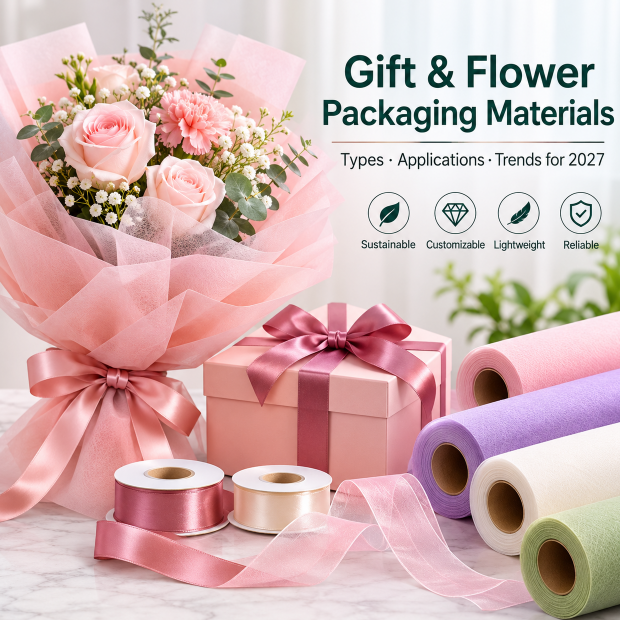
For B2B buyers, the material decision in 2027 is no longer only a question of “what looks good.” It is a question of what performs across transit, what a procurement team can document, and what a supplier can repeat at volume.
What this guide covers: the material set used in gift and floral packaging, the specific role of PP spunbond nonwoven fabric, the supporting function of decorative ribbon, and the trends that should shape 2027 sourcing conversations.
1. Common Materials Used in Gift and Flower Packaging
A working gift or floral packaging system rarely relies on one substrate. Kraft paper, tissue, nonwoven fabric, transparent films, textile fibers, and ribbon are combined according to protection requirements, brand position, and processing route.
Kraft Paper
The default low-to-medium cost option for retail and event packaging. It offers strong printability and a natural aesthetic, and FSC-certified grades are widely available. Its limitations are structural: single-use durability is medium, and moisture contact degrades the sheet quickly. For gift bags and wraps that need repeated handling or floral moisture exposure, kraft paper alone is often insufficient.
Tissue Paper
Used primarily as an inner layer—void fill, surface protection, and the “unboxing” layer inside gift boxes and bouquet sleeves. It is low cost and highly customizable in color, but contributes almost nothing to structural protection or moisture management.
PP Nonwoven Fabric
A spunbond polypropylene sheet that sits between paper and textile in performance. It is breathable, water-resistant, tear-resistant, and printable. In floral and gift packaging it functions as a wrap, sleeve, bag body, or box lining rather than a purely decorative layer. Its specification range is wide: basis weights from roughly 9–10 gsm up to 150–220 gsm depending on the supplier and end use, with 50–80 gsm common for wrapping and 60–80 gsm frequently specified for gift and flower wrap. The material is covered in detail in Section 2.
OPP, BOPP and Transparent Films
Clear films provide product visibility and moisture barrier, and are common in retail display packaging and e-commerce protection. Their weakness in the 2027 context is recyclability: mixed-material constructions involving film windows or film wraps complicate the packaging’s end-of-life profile, a point addressed in Section 4.
Textile and Natural Fiber Materials
Jute, cotton, linen, and similar fibers appear in premium and “natural texture” gift packaging, particularly as handles, ties, or accent layers. They carry strong tactile and sustainability signals but are higher cost and less uniform in processing than nonwoven or paper substrates.
Decorative Ribbons
Ribbon is not a primary protective material, but it is a finishing and brand-identification component used across gift boxes, bouquet wraps, and retail bags. Section 3 treats ribbon as a supporting material rather than a co-equal substrate to nonwoven.
2. PP Nonwoven Fabric for Gift and Flower Packaging
PP spunbond nonwoven fabric is the material in this category that most directly bridges the performance gap between paper and textile. It is produced in a continuous process from polypropylene pellets—melting, spinning, web formation, and thermal bonding—without the chemical binders used in some other nonwoven routes. For packaging buyers, that production route matters because it translates into consistent breathability, moisture resistance, and mechanical strength in the finished sheet.
Why PP Nonwoven Fabric Is Used in Floral Packaging
Fresh flowers continue to respire after harvest. If the wrap traps moisture and ethylene, condensation forms on petals, mold risk rises, and vase life shortens. PP spunbond nonwoven addresses this through even, surface-wide breathability: air circulates across the entire sheet rather than through discrete perforations, allowing ethylene to dissipate and moisture vapor to escape without creating the weak points that perforated films introduce.
At the same time, the material is water-resistant. Unlike paper wraps that absorb moisture, soften, and tear when stems or condensation are present, PP nonwoven maintains its structure and appearance through handling and display. For export and courier flows, this combination—breathable on the inside, water-resistant on the outside—is the functional case for nonwoven over paper in floral wrapping.
Mechanically, spunbond PP conforms to irregular bouquet shapes while resisting pulls and tears, and it remains lightweight, which matters for courier freight. For gift packaging, the same properties support reusable bag constructions and box linings where paper would degrade after limited handling.
Common Applications of Nonwoven Fabric
Floral wrapping and sleeves. The highest-volume packaging application. Rolls and cut sheets are used for bouquet wraps, stem sleeves, and outer protection during transport. Embossed patterns (sesame, square, floral, star) are available for texture differentiation.
Gift bags and tote bodies. Nonwoven is widely used as the body material for reusable gift bags and retail totes. Load capacity for standard constructions is in the range of 5–15 kg depending on gsm and seam construction, which places it above typical paper gift bags for repeat-use applications.
Box linings and soft protection. Thin nonwoven grades serve as liners for gift boxes and jewelry packaging, providing soft contact protection and a tactile upgrade without the bulk of foam or the recyclability complications of EVA inserts.
Table and display accents. In floral retail and event settings, nonwoven is also used for table runners and display surfacing, extending the material’s role beyond the package itself.
Customization Options for Nonwoven Packaging Materials
Print and surface customization is a practical differentiator for B2B buyers. The two dominant print routes are:
- Screen printing: cost-efficient for simple logos and 1–6 spot colors; best suited to runs above roughly 500 units where setup cost is amortized.
- Heat transfer: appropriate for full-color or photographic designs, including smaller runs, though durability is moderate compared with screen print.
Surface texture is a separate customization layer. Embossed patterns change both the visual finish and the hand feel, allowing a converter or brand to move between a soft matte look and a more defined, “paper-look” texture without changing substrate.
Color matching is available across standard ranges (white, bright red, yellow, blue, green) and custom colors. For buyers specifying recycled or certified grades, GRS-certified PP nonwoven and rPET options are increasingly available from established suppliers, alongside OEKO-TEX and SGS documentation.
Important Specifications Buyers Should Consider
Basis weight (gsm) is the primary specification lever. Lower weights (around 30–50 gsm) give a lighter, more translucent wrap suitable for delicate bouquet presentation. Mid-weights (60–80 gsm) balance strength, opacity, and print surface and are the common working range for gift and flower wrap. Higher weights (100–150 gsm and above) move toward bag bodies and applications requiring greater tensile strength and rigidity.
Width and roll format should match the cutting or converting equipment. Common roll widths run from 80 cm to 240 cm, with custom widths available; cut-sheet formats (e.g., 50 × 70 cm) are also standard for florist use.
Certification and documentation deserve a place on the specification sheet, not a footnote. At minimum, buyers sourcing for European or North American retail programs should request GRS (where recycled content is claimed), OEKO-TEX Standard 100, and relevant SGS or REACH documentation. The certification is only useful if it is traceable to the production lot.
MOQ and supply format vary by product type. Fabric rolls are frequently quoted at MOQ levels in the range of 2,000 kg, while finished bags or cut-wrap programs may start at 500–2,000 pieces depending on customization. Buyers should confirm whether MOQ applies per color, per size, or per construction, because that distinction changes the effective minimum commitment.
3. The Role of Ribbon in Gift and Floral Packaging
Ribbon should be treated as a finishing component, not a primary material platform. It does not protect the product, manage moisture, or carry structural load. Its value lies in closure, brand identification, and the tactile-visual layer that completes the package.
Common Types of Ribbon
Satin and grosgrain ribbons remain the standard for gift and floral finishing, offering a smooth or ribbed surface respectively. Matte cotton and jute twine are used where a natural, uncoated aesthetic is specified. Paper-based ribbons and heat-sealed synthetic blends are also common in high-volume floral programs, where edge integrity and bow-making consistency matter more than a soft hand feel.
How Ribbon Enhances Packaging Design
The practical selection rule is finish matching: matte wrappers—nonwoven, kraft, classic floral paper—pair with matte cotton, jute, or uncoated ribbon to maintain a coherent surface language; high-shine satin is better reserved for smoother or glossier substrates. For wedding and celebration programs, floral-patterned ribbons can be combined with logos or seasonal graphics to create a coordinated presentation without changing the primary wrap.
Ribbon also functions as a brand carrier at low cost. A custom-printed ribbon can carry the brand mark or a seasonal message across both gift and floral SKUs, allowing a single ribbon inventory to serve multiple packaging formats.
Combining Nonwoven Fabric with Decorative Ribbon
The nonwoven-plus-ribbon combination is a practical B2B pairing rather than a purely aesthetic one. Nonwoven provides the breathable, water-resistant wrap; ribbon provides the closure and the contrasting finish. For floral bouquets, a jute or matte cotton ribbon over a 60–80 gsm embossed nonwoven wrap creates a natural-texture system that reads as intentional rather than generic. For gift bags, a grosgrain or satin ribbon handle or belly band can lift the perceived value of a nonwoven body without requiring a more expensive substrate change.
The sourcing implication is straightforward: specify ribbon as a coordinated accessory to the nonwoven program, with matched color references and compatible finish, rather than as an independent line item.
4. Gift and Flower Packaging Trends for 2027
The 2027 trend picture is shaped less by color cycles than by regulatory timelines and procurement auditability.
Regulatory timeline to plan around: the EU Packaging and Packaging Waste Regulation (PPWR), Regulation (EU) 2025/40, applies generally from 12 August 2026. Administrative obligations come into effect in 2027, and from 1 January 2030 only packaging compliant with the regulation’s environmental standards may be marketed in the EU. For floral gifts specifically, the regulation affects packaging minimisation, recyclability, recycled content in plastic packaging, and documentation.
Sustainable and Recyclability-Focused Packaging
Recyclability is moving from a marketing claim to a design criterion. PPWR requires packaging to be recyclable and introduces design-for-recycling criteria, with performance assessment against those criteria from 2030. The practical consequence for buyers is that mixed-material constructions—paper box with a plastic window, foam insert, and laminated surface—become harder to defend. A single-material or mono-material approach simplifies both the recycling route and the documentation file.
For PP nonwoven, the recyclability story is strongest when the package is kept as a mono-PP stream or when the nonwoven component can be separated cleanly from paper or ribbon accessories. Buyers should ask suppliers for the recyclability profile of the specific construction, not just the substrate datasheet.
Natural Textures and Expressive Color Combinations
Texture continues to carry brand meaning. Embossed nonwoven, uncoated kraft, and matte ribbon finishes signal a tactile, less “plastic” presentation. The 2027 differentiation is in surface consistency across materials: a matte nonwoven wrap with a matte cotton ribbon, or an embossed nonwoven gift bag with a paper-based handle, reads as a coherent design decision rather than a mix of unrelated components. Color direction favors natural tones and controlled accent colors over high-saturation novelty, with brand color applied through print or ribbon rather than through substrate tinting where possible.
Personalized and Custom-Printed Packaging
Customization in 2027 is less about one-off personalization and more about programmable repeatability. A brand may run multiple SKUs, seasonal variants, and retailer-specific packs from the same nonwoven base fabric, changing only the print artwork or ribbon. This favors substrates with reliable print surfaces and suppliers who can hold color consistency across repeat orders. For B2B buyers, the relevant question is not “can you print my logo?” but “can you maintain the same print result across the next three reorders?”
Mixed-Material Packaging Designs
Mixed-material designs still have a place, particularly where protection or presentation requires it—a nonwoven wrap with a ribbon closure, or a nonwoven bag with a paper header card. But the 2027 standard is that every component must be declarable and compatible with the intended end-of-life route. The practical approach is to treat each added component (ribbon, label, insert) as a separate specification item with its own material and recyclability note, rather than assuming the primary substrate covers the whole package.
Functional and Lightweight Packaging
E-commerce growth continues to reward lightweight, protective formats. Nonwoven’s strength-to-weight ratio supports this: a 60–80 gsm wrap provides tear resistance and moisture protection at a lower weight than many paper alternatives. Packaging minimisation requirements also push toward removing unnecessary layers and void space, which aligns with a single nonwoven wrap or bag replacing a multi-layer paper-plus-film construction where the protection function is equivalent.
5. How to Choose the Right Packaging Materials for Your Business
The material decision should be framed as a specification exercise, not a catalog browse.
Material performance and product protection. Define the actual stress profile of the shipment: moisture exposure, compression, handling cycles, and transit duration. For fresh flowers, breathability and moisture management are non-negotiable; for gift items, tear resistance and print surface may take priority. A 60–80 gsm nonwoven may be the correct functional specification for a bouquet wrap and an underspecification for a heavy gift bag.
Appearance and brand positioning. Match the substrate finish to the intended brand signal. Nonwoven offers a matte, soft hand feel; embossed patterns add texture without lamination. Ribbon and print carry the color and logo layer. The goal is a coherent material language, not a collection of individually attractive components.
Customization and manufacturing requirements. Confirm the print method against run size: screen print for volume and spot colors, heat transfer for complex artwork or smaller runs. Confirm whether the supplier can hold color and gsm tolerance across reorders. For cut-and-sew formats (bags, sleeves), confirm seam construction and load specification, not just fabric gsm.
Cost, MOQ, and supply reliability. The quoted FOB price is only one line in the landed-cost calculation. Ask for: MOQ per color/size; production lead time from deposit and artwork approval; available production capacity during peak floral seasons; and whether the supplier holds stock programs for repeat items. Typical nonwoven roll production lead times in the range of 15–30 days are workable for planned programs, but seasonal peaks require earlier commitment. A supplier with multiple production lines and documented capacity is a lower supply-risk profile than a trader with variable sourcing.
A practical sourcing checklist for 2027:
- Material: gsm, width, surface (plain/embossed), certification (GRS/OEKO-TEX/SGS).
- Function: breathability, water resistance, tensile/tear performance for the intended load.
- Compliance: recyclability route, recycled content if claimed, documentation availability.
- Customization: print method, color target, artwork repeatability.
- Commercial: MOQ definition, lead time, capacity, repeat-order consistency.
6. Why NW Fabric for Nonwoven Packaging Materials
NW Fabric operates as a PP spunbond nonwoven manufacturer serving packaging converters, floral suppliers, and gift packaging buyers. The relevant capabilities for a 2027 procurement program are:
Material range and customization. PP spunbond nonwoven in basis weights spanning the packaging working range, with plain and embossed surfaces, custom widths, and color matching. Print-ready surfaces support screen and heat-transfer decoration for brand and retailer programs.
Certification and documentation. GRS, OEKO-TEX, and SGS documentation are available for buyers building compliance files for European and North American retail. Certification is only useful when it is traceable to the shipment, and supplier documentation should be requested at the quotation stage rather than after order confirmation.
Production capacity and supply stability. Multiple spunbond lines and a defined monthly capacity support repeat-order programs and seasonal volume planning. Lead-time commitments should be confirmed against the specific construction and print requirement, not assumed from a generic fabric lead time.
Packaging-specific support. The team works with buyers on gsm selection, width specification, embossing pattern, and print method selection for gift and floral applications. The goal is a specification that can be quoted, sampled, and repeated—not a one-off sample that cannot be reproduced at volume.
Frequently Asked Questions
Is PP nonwoven fabric recyclable?
PP spunbond is a thermoplastic polypropylene material and can be recycled in mono-PP streams where collection infrastructure exists. Recyclability of the finished package depends on the full construction: a nonwoven wrap alone has a simpler recycling route than a nonwoven bag with a mixed-material handle or lamination. Buyers should specify the full component list and request the recyclability profile for the construction, not just the substrate.
What gsm is appropriate for fresh flower wrapping versus gift bags?
For floral wrapping, 50–80 gsm is the common working range: light enough for bouquet presentation, strong enough for handling and moisture resistance. For gift bags and tote bodies, 70–100 gsm and above is typical, with load capacity also dependent on seam construction. The correct specification should be set against the actual load and handling profile rather than a single “best” gsm.
Can nonwoven fabric be custom-printed with a brand logo?
Yes. Screen printing is cost-effective for simple logos and spot colors at volume; heat transfer supports full-color and photographic designs, including smaller runs. The print method should be selected against run size, color complexity, and required durability.
Does nonwoven fabric work for both gift packaging and flower packaging?
Yes, but the specification differs. Floral wrapping prioritizes breathability, moisture resistance, and drapability at lower gsm. Gift packaging prioritizes tear strength, print surface, and load capacity at higher gsm and in bag or box-lining formats. The shared material platform allows a buyer to source both from a single nonwoven supplier, but the SKU specifications should be treated separately.
What should B2B buyers ask a nonwoven supplier before placing a 2027 order?
At minimum: certification documents traceable to the production lot; MOQ definition by color and size; production lead time from deposit and artwork approval; repeat-order color and gsm tolerance; and the recyclability profile of the specific construction. For EU-bound programs, request documentation that supports the PPWR administrative and design requirements applicable from 2027 and 2030.
Conclusion
The 2027 gift and floral packaging material decision is a specification decision. Kraft paper, tissue, transparent films, and ribbon each retain a defined role, but PP spunbond nonwoven fabric offers a combination that few other substrates match: surface-wide breathability for fresh flowers, water resistance where paper fails, tear strength at low weight, and a print surface that supports brand programs. The regulatory direction—PPWR administrative obligations in 2027, design requirements from 2030—rewards buyers who can document material choices and keep constructions simple enough to recycle.
Next step for buyers: the productive move is not a general inquiry but a specification brief—gsm, width, surface, print method, certification, MOQ, and intended end-of-life route. A supplier who can quote against that brief, sample it, and repeat it across reorders is worth more in 2027 than a lower FOB price with undocumented material.