
Air filtration systems play a critical role in improving indoor air quality and protecting both people and equipment from airborne particles. From household air purifiers to industrial filtration systems, modern air filters rely on advanced materials to capture dust, pollen, bacteria, and fine particles.
One of the most widely used material categories in filtration is Nonwoven Fabric. Nonwoven materials are favored because they provide excellent filtration efficiency, airflow performance, and structural flexibility.
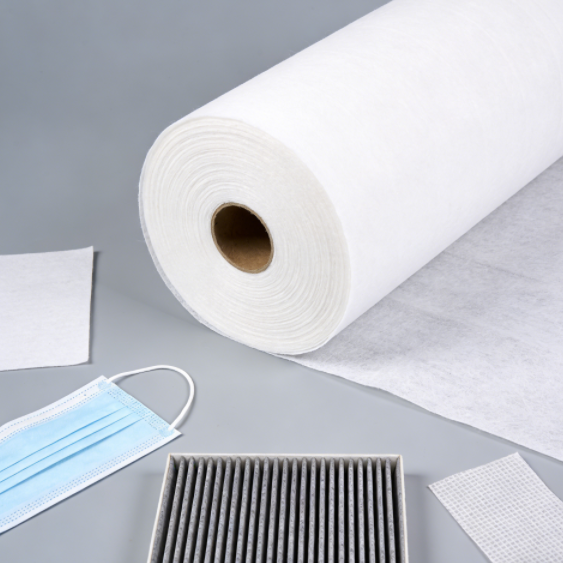
This article explores the most common types of nonwoven fabrics used in air filters, their properties, and how they contribute to high-performance filtration systems.
Why Nonwoven Fabrics Are Ideal for Air Filtration
Before exploring specific materials, it is important to understand why nonwoven fabrics are widely used in filtration applications.
Compared with traditional woven textiles, nonwoven materials offer several advantages:
- High porosity for improved airflow
- Adjustable fiber structure for filtration efficiency
- Lightweight construction
- Cost-effective manufacturing
- Easy integration into composite filter structures
Because of these properties, nonwoven fabrics have become the foundation of modern filtration media used in air purifiers, HVAC systems, automotive filters, and industrial filtration equipment.
1. Meltblown Nonwoven Fabric
One of the most important filtration materials is Meltblown Nonwoven Fabric.
Meltblown nonwoven fabric is produced by extruding molten polymer through extremely fine nozzles to create microfibers with diameters often smaller than 5 microns.
Key characteristics
- Extremely fine fiber diameter
- High filtration efficiency
- Electrostatic particle capture capability
Typical applications
- HEPA filter media
- face mask filtration layers
- air purifier filters
- industrial air filtration
Because of its ability to capture very fine particles, meltblown fabric is often used as the primary filtration layer in air filters.
2. Spunbond Nonwoven Fabric
Another widely used material in filtration systems is Spunbond Nonwoven Fabric.
Spunbond nonwoven fabrics are produced by extruding continuous filaments that are then bonded together to form a durable fabric structure.
Key characteristics
- High tensile strength
- Excellent durability
- Good airflow properties
Typical applications
- pre-filtration layers
- protective outer filter layers
- structural components of filtration media
Spunbond fabrics are typically used as support layers or protective layers in multi-layer filtration systems.
3. Skeleton Nonwoven Fabric
Modern air filtration systems increasingly use Skeleton Nonwoven Fabric as a structural backing layer.
Unlike primary filtration media, skeleton nonwoven fabrics are designed to provide mechanical stability and airflow support within composite filter structures.
Key characteristics
- high stiffness
- lightweight structure
- excellent air permeability
- open fiber network
Typical applications
- air purifier filters
- vacuum cleaner filters
- automotive cabin air filters
- composite meltblown filtration media
- activated carbon filter structures
By reinforcing delicate filtration layers such as meltblown media, skeleton nonwoven fabrics help maintain filter shape and performance during operation.
4. Needle-Punched Nonwoven Fabric
Another filtration material sometimes used in industrial applications is Needle Punched Nonwoven Fabric.
This material is produced by mechanically entangling fibers using barbed needles.
Key characteristics
- thick structure
- high durability
- good dust holding capacity
Typical applications
- industrial dust filtration
- baghouse filters
- heavy-duty air filtration systems
Needle-punched fabrics are commonly used in industrial filtration environments where filters must withstand harsh conditions.
5. Coarse denier Nonwoven Fabric
Another important category is Coarse Denier Nonwoven Fabric.
Coarse denier nonwovens have advantages over fine-denier nonwovens, as they generally have better tensile strength, tear resistance, and abrasion resistance. They also provide a good barrier to liquids and have high porosity, making them ideal for filtration and drainage applications.
Key characteristics
- uniform fiber dispersion
- controlled pore structure
- high consistency
Typical applications
- Face masks supporting layer
- Dust filtration
- Air cleaner filter skeleton
- Automobile air conditioning filter skeleton
How Composite Air Filters Use Multiple Nonwoven Layers
Most high-performance air filters combine several types of nonwoven fabrics to achieve optimal performance.
A typical filter structure may include:
Pre-filtration layer → Spunbond nonwoven
Fine filtration layer → Meltblown nonwoven
Adsorption layer → Activated carbon
Support layer → Skeleton or Coarse denier nonwoven
This multi-layer design allows filters to achieve both high filtration efficiency and low airflow resistance.
How to Choose the Right Nonwoven Fabric for Air Filters
When selecting nonwoven materials for filtration applications, manufacturers typically consider several factors:
Filtration efficiency requirements
Fine particle filtration requires materials such as meltblown fabrics.
Airflow resistance
Support layers should maintain airflow while stabilizing the filter structure.
Mechanical strength
Structural materials must withstand airflow pressure and long-term operation.
Compatibility with composite structures
Many filters combine multiple materials, so compatibility is essential.
Choosing the right combination of nonwoven fabrics helps manufacturers achieve the best balance between filtration performance, durability, and cost efficiency.
Future Trends in Filtration Nonwoven Materials
As air quality concerns grow worldwide, filtration technology continues to evolve. New materials and structures are being developed to improve filter efficiency and sustainability.
Trends in filtration nonwoven materials include:
- lightweight composite structures
- improved airflow performance
- advanced fiber engineering
- recyclable filtration materials
These innovations will continue to shape the future of air filtration technology.
FAQ
What type of nonwoven fabric is best for air filtration?
The best material depends on the filtration requirement. Meltblown fabrics provide high filtration efficiency, while support materials like skeleton nonwoven fabrics improve filter stability.
Why are multiple nonwoven layers used in air filters?
Multi-layer structures combine different functions such as particle capture, structural support, and airflow control to achieve optimal filtration performance.
Are nonwoven fabrics reusable in air filters?
Most nonwoven filtration materials used in consumer air filters are designed for single-use replacement to maintain optimal filtration efficiency.