
When requesting a quotation for nonwoven fabric, simply asking for “80 GSM PP nonwoven fabric” is usually not enough.
Different suppliers need to know: What material? What GSM? What width? What application? What color? How much do you need? How should the fabric be supplied? What performance requirements do you have?
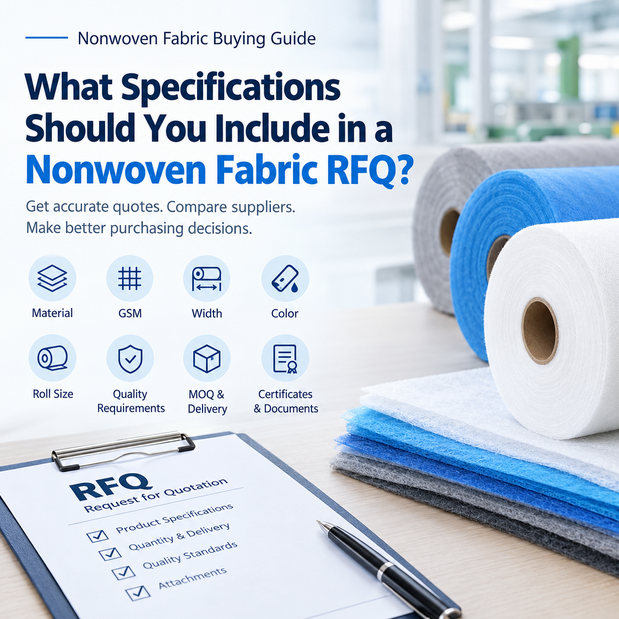
If this information is incomplete, suppliers may need to repeatedly follow up with clarifying questions — or worse, different suppliers will quote against different specifications, making their prices impossible to compare.
This guide explains the key specifications to include in a nonwoven fabric RFQ and provides a practical RFQ checklist you can send directly to suppliers.
What Is an RFQ for Nonwoven Fabric?
RFQ stands for Request for Quotation. When a buyer sends an RFQ to a supplier, the buyer is essentially saying:
“Exactly what product do I need, how much do I need, and what requirements must it meet?”
A vague inquiry might look like this:
Please quote 80 GSM PP nonwoven fabric.
A complete inquiry looks like this:
Please quote 80 GSM virgin PP spunbond nonwoven fabric, 1600 mm width, white, 50,000 kg, supplied in rolls for disposable product manufacturing.
The difference in clarity directly affects the quality and speed of the quotation you receive.
Because so many buyers skip critical details, some suppliers have learned to quote narrow ranges or add conditional pricing. But when you specify everything upfront, suppliers can give you a firm, comparable quote. And when you request quotes from multiple suppliers using the same specification sheet, you can evaluate them side by side without wondering whether one quote is for a lighter fabric or a different treatment.
Once your RFQ includes the right level of detail, the supplier can calculate material costs, production scheduling, and shipping accurately. You get a quote you can actually use — not a placeholder that requires ten more emails to refine.
12 Key Specifications to Include in a Nonwoven Fabric RFQ
1. Material
Start by specifying the raw material. Common options include virgin PP, recycled PP, polyester, viscose, PLA, and other specified fibers.
Don’t simply write “PP nonwoven.” State whether you require virgin PP, recycled PP, or another material. The material choice affects strength, appearance, processing performance, application suitability, and cost. For example, a converter producing medical drapes will have very different material requirements from a manufacturer making reusable shopping bags.
2. Manufacturing Process
This is one of the most commonly overlooked specifications.
Nonwoven fabric can be produced through spunbond, meltblown, spunlace, needle punched, thermal bonded, and other processes. Each process produces fabric with different structural characteristics — spunbond offers high strength for durable applications, meltblown provides fine fiber filtration for barrier applications, and spunlace delivers softness and drape for hygiene products.
If the manufacturing process is important for your application, specify it in the RFQ. Many product manufacturers don’t just need “nonwoven fabric” — they need a specific process type that is compatible with their downstream converting equipment.
3. Basis Weight / GSM
GSM stands for grams per square meter. Typical commercial options range from 20 GSM to 120 GSM, though heavier weights are available for specialized applications.
Specify the target GSM and acceptable tolerance if your application requires tight control. As a reference, standard commercial tolerance is often ±5% to ±10% of the nominal GSM, depending on the production process and quality tier. Tighter tolerance, such as ±3%, may be available at a higher cost.
Don’t just write “approximately 80 GSM.” For industrial production, state the target value and the acceptable tolerance range clearly. This prevents disputes when incoming inspection measures a slightly different weight.
4. Fabric Width
Width affects production efficiency, material waste, slitting requirements, and machine compatibility. Common widths include 1000 mm, 1200 mm, 1600 mm, 2000 mm, and 2600 mm.
For converters especially, width is critical. If the fabric needs to be slit to a narrower width, confirm whether the supplier can deliver the exact width or whether you will handle slitting in-house. Width tolerance matters too — typical commercial tolerance is around ±0.5 cm, but this can vary.
Before requesting a quotation, confirm the maximum and minimum available width from the supplier. Some manufacturers can produce up to 3200 mm, while smaller lines may max out at 1600 mm.
5. Color
If you need white fabric, simply state “white.” For colored fabric, specify black, blue, green, red, or custom color requirements.
For custom colors, provide a Pantone reference, a physical color sample, and a color tolerance. Typical color tolerance for nonwoven fabric is ΔE ≤ 1.0–1.5 for tight color matching, though wider tolerances may be acceptable depending on the application. Custom colors usually require a higher minimum order quantity — often 500–1,000 kg per color.
6. Tensile Strength
Tensile strength is measured in both machine direction, MD, and cross direction, CD. Two fabrics with identical GSM can have very different strength profiles depending on fiber orientation, bonding method, and raw material.
Typical target values for disposable nonwoven fabric range from 60–120 N/5cm in MD and 40–90 N/5cm in CD, depending on GSM and application. For industrial or geotextile applications, higher strength values are required.
Don’t assume GSM alone determines performance. If your application involves tension during converting or end-use stress, specify MD and CD tensile requirements in the RFQ.
7. Functional Requirements
Depending on your application, you may need one or more functional treatments: water resistance, hydrophilic treatment, hydrophobic treatment, antistatic properties, flame retardancy, UV resistance, breathability, filtration performance, softness, or other application-specific requirements.
Hydrophilic and hydrophobic treatments are among the most common. A hydrophilic treatment allows liquid to pass through the fabric — essential for wipes, absorbent layers, and medical drapes. A hydrophobic treatment repels liquid — required for protective barriers and backsheets. Antistatic treatment modifies conductivity to prevent static buildup, which matters for electronics packaging and cleanroom applications.
Only specify the properties that are actually required for your application. Adding unnecessary requirements increases cost without adding value.
8. Roll Length
Typical roll lengths range from 100 m to 7,500 m, depending on fabric weight and thickness. Standard options include 100 m/roll, 500 m/roll, and 1,000 m/roll, but custom lengths are often available.
Roll length matters because it affects shipping cost, warehouse space, and production efficiency. Longer rolls mean fewer roll changes on the production line, but they also require more storage height and handling equipment.
9. Roll Diameter, Core Size, and Roll Weight
This is where many RFQs fall short — and where production problems begin.
Specify the maximum acceptable roll diameter and the required core diameter. The 3-inch, or 76.2 mm, paper core is the industry standard for most nonwoven rolls, but 2-inch and 6-inch cores are also available depending on the supplier’s production line.
Typical roll diameters range from 25 cm to 100 cm, and roll weights range from 10 kg to 500 kg. If the material will be fed directly into automated production equipment, include core size, maximum roll diameter, and maximum roll weight in the RFQ. A roll that is too heavy for your unwind stand or too large for your splice station will cause downtime regardless of fabric quality.
10. Order Quantity
Don’t just ask “MOQ?” Tell the supplier your full quantity picture:
- Trial order quantity
- Monthly requirement
- Annual requirement
- Expected repeat order frequency
For example: Trial order: 500 kg; First bulk order: 5,000 kg; Estimated annual demand: 50,000 kg.
Suppliers use these numbers to calculate production scheduling, raw material procurement, and pricing tiers. A supplier who knows you will place repeat orders is often willing to offer better pricing than for a one-time purchase.
11. Delivery Requirements
Include the required delivery date, destination, shipping method, and any partial shipment requirements.
For example: Required delivery: within 30 days after order confirmation; Destination: Los Angeles port; Shipping method: FCL.
If you need the fabric delivered in multiple shipments or to multiple locations, state this upfront. It affects packaging and logistics planning.
12. Quality Standards and Documentation
This specification is important but often misunderstood. You can request a product specification sheet, test reports, Certificate of Analysis, COA, MSDS/SDS when applicable, REACH, RoHS, OEKO-TEX, ISO-related documentation, or other customer-specific requirements.
REACH compliance is mandatory for any nonwoven fabric imported into the EU — it restricts SVHC substances above 0.1%. OEKO-TEX Standard 100 certification is voluntary but frequently required by brand-name buyers in hygiene, apparel, and baby product supply chains. GRS certification verifies recycled content claims for rPET grades.
However, don’t treat all certifications as mandatory. Determine which certifications are actually required based on your end-use application, target market, and customer requirements. Requesting certifications you don’t need adds cost and narrows your supplier pool unnecessarily.
Nonwoven Fabric RFQ Checklist
Use this table as a reference when preparing your RFQ. Every row represents a specification that suppliers need to provide an accurate, comparable quotation.
| Specification | What to Provide |
|---|---|
| Material | Virgin PP, recycled PP, polyester, viscose, PLA, etc. |
| Manufacturing Process | Spunbond, meltblown, spunlace, needle punched, thermal bonded |
| GSM | Target GSM + acceptable tolerance |
| Width | Required width + width tolerance |
| Color | Standard or custom color, Pantone reference if applicable |
| Application | Intended end use |
| Tensile Strength | MD/CD requirements in N/5cm |
| Functional Properties | Hydrophilic, hydrophobic, antistatic, flame retardant, UV stabilized, etc. |
| Roll Length | Required meters per roll |
| Roll Diameter | Maximum/minimum if applicable |
| Core Size | Inner core diameter, e.g., 76 mm / 3 inch |
| Order Quantity | Trial / bulk / annual volume |
| Packaging | Required packaging method: poly bag, stretch film, carton, pallet |
| Delivery | Required date and destination |
| Quality Documents | Test reports / certificates / compliance declarations |
| Sample | Required sample size and quantity |
A Practical Nonwoven Fabric RFQ Template
You can copy the template below and send it directly to suppliers. Fill in your specific requirements and delete any lines that do not apply to your application.
Subject: RFQ – Nonwoven Fabric

Dear [Supplier],

Please provide your quotation for the following nonwoven fabric:

Material:
Manufacturing Process:
GSM:
GSM Tolerance:
Width:
Width Tolerance:
Color:
Application:
Tensile Strength (MD/CD):
Functional Requirements:
Roll Length:
Core Size:
Roll Diameter:
Order Quantity:
Packaging Requirements:
Destination:
Required Delivery Date:
Required Certifications / Test Reports:

Please also provide:
- Product specification sheet
- MOQ
- Sample availability
- Lead time
- Payment terms
- Shipping terms

Please indicate your price based on the above specifications.

Best regards,
[Name]
[Company]
Common Mistakes When Requesting a Nonwoven Fabric Quotation
1. Only specifying GSM
“I need 80 GSM nonwoven fabric” tells the supplier almost nothing about material, width, process, or performance requirements. The quote will either be wildly inaccurate or require extensive follow-up.
2. Not specifying the application
Without knowing the end use, the supplier cannot recommend or verify whether the material grade is suitable. A fabric for agricultural covers and a fabric for medical drapes are not interchangeable, even at the same GSM.
3. Not specifying width
Width determines cutting efficiency, waste percentage, and whether the fabric can be used directly on your production line. Omitting width makes quotes incomparable.
4. Not specifying quantity
MOQ and price depend heavily on volume. A supplier quoting for 500 kg may have very different pricing from one quoting for 50,000 kg. State your trial, monthly, and annual quantities.
5. Ignoring roll specifications
If the roll is too heavy for your unwind equipment, or the core size doesn’t match your mandrel, you’ll face production downtime regardless of fabric quality.
6. Asking only for the lowest price
Price must be compared against specifications, quality tolerance, and delivery terms. The cheapest quote may reflect lower GSM, wider tolerances, or slower lead times.
7. Not defining quality tolerance
Without agreed tolerances for GSM, width, and color, there is no objective basis for accepting or rejecting incoming material. Disputes arise when expectations were never written down.
How Suppliers Use Your RFQ to Prepare a Quote
When a supplier receives a complete RFQ, they move through a straightforward process:
RFQ → Specification Review → Material Calculation → Production Planning → Costing → Quotation
At each stage, the supplier makes assumptions when information is missing. Those assumptions introduce risk — and risk gets priced into the quote, or worse, leads to disputes after the order is placed.
A complete RFQ reduces assumptions at every stage. Material calculation is precise because GSM and width are confirmed. Production planning is efficient because roll specifications and quantity are clear. Costing is accurate because functional treatments and certifications are specified upfront.
The more complete your RFQ is, the fewer assumptions the supplier needs to make — and the faster you receive a usable quotation.
What If You Don’t Know All the Specifications?
Many buyers know what product they want to manufacture but don’t know exactly what nonwoven specifications they need. This is common, especially for companies transitioning from another material or developing a new product.
If this describes your situation, you can still send a productive RFQ. Provide what you do know:
- End-use application — what the fabric will be used for
- Product drawings or specifications for the finished product
- An existing material sample from a current supplier
- Current supplier specification sheet, even if you’re looking to switch
- Production machine information — width capacity, unwind type, line speed
- Required performance characteristics — what the fabric must withstand
- Target order quantity and timeline
The supplier can then recommend suitable specifications for material, GSM, width, roll configuration, functional treatment, and other parameters based on your actual requirements. This is often more productive than guessing at specifications you’re not sure about.
If you are comparing multiple suppliers, note that each may recommend slightly different specifications. The RFQ process is the right time to identify and resolve these differences — not after the first production run.
Need Help Preparing Your Nonwoven Fabric RFQ?
Not sure which nonwoven fabric specifications are suitable for your application? Send us your product requirements, current material specification, or sample details. Our team can review your requirements and recommend suitable material specifications for bulk production.