
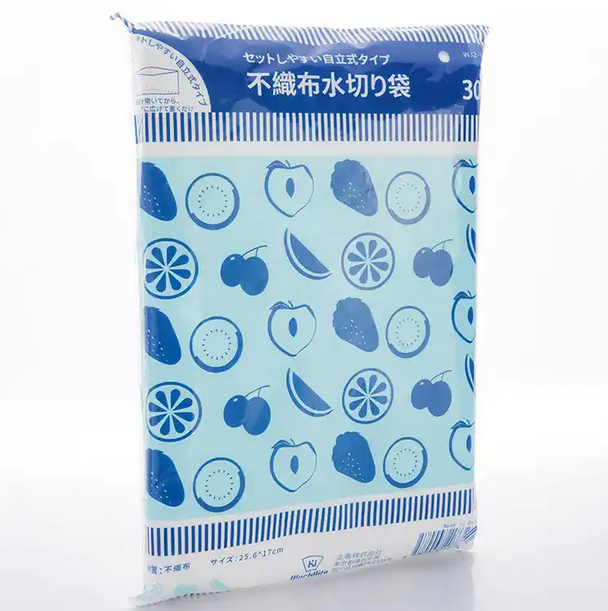
If you have ever stepped into a Japanese home goods store or browsed a trending kitchenware section online, you have likely seen them: the neatly packaged, pastel-colored “Mizukiri-bukuro” (water-draining bags) adorned with charming fruit patterns like strawberries, apples, and cherries. While these disposable sink strainer bags look playful and decorative on the surface, they represent a sophisticated intersection of Japanese household efficiency and modern nonwoven material science.
In recent years, these kitchen sink strainer bags have become a staple in Japanese households, and their popularity is steadily spilling over into global markets. For manufacturers and brands looking to enter this niche, understanding why these bags succeed in Japan is just as important as understanding the raw materials behind them.
The Japanese “Waste-Draining” Culture
In Japan, daily kitchen waste management is a meticulous ritual. With limited recycling space and a high awareness of hygiene, Japanese consumers are obsessed with minimizing the “drip” and odor of wet garbage.
The “Mizukiri-bukuro” serves a crucial dual purpose:
- Drainage: Placed directly into a sink strainer basket, it immediately separates liquid from solid food scraps (tea leaves, peels, and coffee grounds).
- Odor Containment: By drastically reducing water content before the bag is tied up and discarded, it prevents the accumulation of rotting liquid in the household trash bin, which is the primary source of unpleasant smells and fruit flies.
This functional necessity has turned a simple disposable bag into a high-turnover daily consumption product.
The Material Science: Why ES Nonwoven Is the Market Standard
Not all nonwoven fabrics are suitable for wet filtration. To succeed in the Japanese market, the material must meet strict performance criteria. This is where ES nonwoven fabric becomes the undeniable industry standard.
ES nonwoven (typically a bi-component of PE and PP fibers) offers specific properties that align perfectly with the demands of the kitchen:
- Instantaneous Water Filtration: The unique fiber structure ensures excellent permeability. Water passes through within seconds, preventing the sink basket from becoming a stagnant puddle.
- High “Wet-Strength”: Unlike paper bags that disintegrate, ES fabric maintains its structural integrity when fully saturated. It allows the user to lift, cinch, and tie the bag without it tearing, even when heavy with wet scraps.
- Lint-Free Drainage: High-quality ES nonwoven is thermally bonded to prevent fiber shedding. This is a critical selling point in Japan, as loose fibers can accumulate in the U-bend of the plumbing, leading to costly blockages.
The “Kawaii” Factor and Lifestyle Marketing
Another key to the success of these drainer bags in Japan is aesthetic packaging. The blue and pastel color schemes with fruit icons are not merely decorative; they are a psychological bridge. By turning a mundane, often “gross” chore (cleaning a sink strainer) into a visually pleasant interaction with cute designs, these products break the barrier of household drudgery.
Furthermore, the “self-standing” (自立式) type packaging is a brilliant piece of industrial design. It allows the consumer to easily open and set the bag onto the sink without needing extra hands, signaling that the product manufacturer has thought deeply about the end-user’s daily pain points. Brands that adopt this design philosophy see significantly higher consumer loyalty.
Key Considerations for Sourcing and Manufacturing
For international brands and OEM manufacturers looking to replicate this success, the devil is in the details. The standard sizing in Japan is typically around 25.6cm x 17cm to fit standard sink baskets, and 30 pieces per pack is the most common SKU.
However, the biggest hurdle for new entrants is the quality consistency of the raw material. Because the fabric is directly exposed to water, food grease, and heat, any variation in the fiber distribution can lead to pinholes, uneven drainage, or sudden breakage.
This is where partnering with a specialized raw material supplier becomes a strategic business move. Established nonwoven manufacturers, such as NW Fabric, have developed proprietary formulations for kitchen filtration. Their Kitchen Sink Strainer Bag nonwoven fabrics are engineered with precise pore sizes and grammages (typically between 13gsm to 15gsm for this application) to ensure uniform performance across millions of bags. For manufacturers, securing a reliable, FSC- or ISO-certified supply chain for this specific grade of ES fabric is the most effective way to guarantee product quality and avoid costly batch rejections.
The Future of Kitchen Filtration
As sustainability and “zero-waste” lifestyles gain global traction, the demand for efficient food-waste management products will only rise. The Japanese “mizukiri-bukuro” is not just a trend; it is a cultural blueprint for practical kitchen hygiene.
By combining functional material innovation (ES nonwoven) with user-centric packaging design (self-standing, aesthetic patterns), manufacturers can create a product that is both essential and enjoyable to use. For those serious about competing in this space, understanding the material’s role in solving real consumer problems is the first step toward building a globally competitive product.
For detailed technical specifications and industry-grade ES nonwoven materials tailored for kitchen drainer bags, you can explore the professional material portfolios offered by specialized manufacturers like NW Fabric, who actively supply the supply chain with high-performance filtration substrates.