
- 1. Introduction: The Sustainability Crossroads
- 2. Understanding Biodegradable Nonwovens
- 3. Understanding Recycled Nonwovens
- 4. Biodegradable vs. Recycled: The Critical Differences
- 5. Which Is Right for Your Product? A Decision Framework
- 6. The Future: Hybrid Approaches & Emerging Technologies
- 7. Conclusion: Making the Informed Choice
- 8. References & Further Reading
Sustainability is no longer a marketing talking point—it has become the central axis around which procurement decisions in the nonwoven industry now revolve. For product developers and sourcing managers, the question is no longer whether to adopt sustainable materials, but which sustainable pathway delivers the best balance of performance, cost, and environmental impact for their specific application.
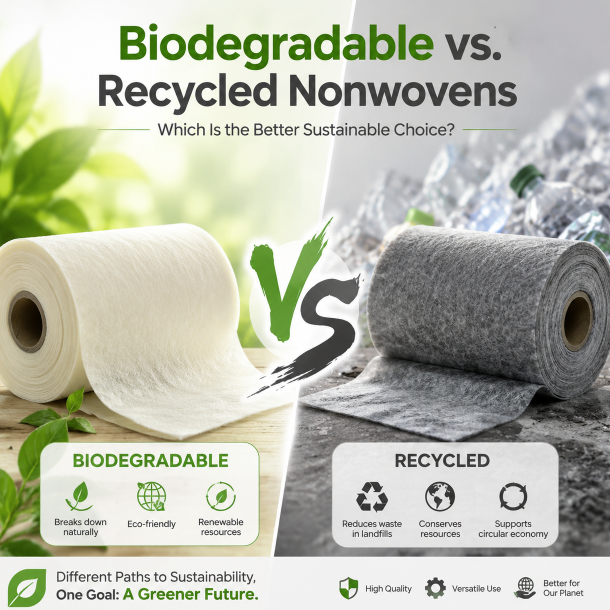
Two contenders have emerged as the leading alternatives to conventional petroleum-based nonwovens: biodegradable nonwovens (derived from bio-based polymers like PLA and PHA) and recycled nonwovens (made from post-consumer or post-industrial waste, typically rPET). Both promise reduced environmental footprints. Both attract regulatory favor and consumer goodwill. Yet beneath the surface, their differences are profound—and choosing incorrectly can undermine both sustainability goals and product performance.
This article moves beyond generic sustainability claims to provide procurement professionals, product developers, and sourcing managers with a data-driven framework for evaluating biodegradable versus recycled nonwovens. We examine material composition, manufacturing economics, performance characteristics, carbon footprints, regulatory trends, and—most critically—the application-specific factors that should guide your decision.
1. Introduction: The Sustainability Crossroads
The global nonwoven fabrics market is undergoing a transformation driven by three converging forces: tightening regulations on single-use plastics, rising consumer demand for eco-conscious products, and increasing ESG (Environmental, Social, and Governance) requirements from corporate buyers.
The numbers tell the story. The global degradable non-woven materials market was valued at USD 1.58 billion in 2024 and is projected to reach USD 3.43 billion by 2032, growing at a CAGR of 11.8%. The broader biodegradable nonwovens market is expected to grow at 12% CAGR and may reach USD 5.8 billion by 2033.
Simultaneously, the recycled nonwoven fabrics market, estimated at USD 5 billion in 2025, is projected to reach approximately USD 9 billion by 2033 at a CAGR of 8%. These parallel growth trajectories reflect a fundamental industry shift: sustainability is no longer optional—it is the new baseline.
But here lies the challenge: biodegradable and recycled nonwovens are not interchangeable. They address different environmental problems, perform differently across applications, and carry distinct cost structures and supply chain risks. Understanding these differences is essential for making procurement decisions that are both commercially sound and genuinely sustainable.
2. Understanding Biodegradable Nonwovens
2.1 What Are Biodegradable Nonwovens?
Biodegradable nonwovens are engineered fabrics produced from natural fibers, biopolymers, or compostable materials designed to decompose in an eco-friendly manner after use. Unlike conventional petroleum-based nonwovens, these materials are engineered to break down under specific environmental conditions, reducing long-term environmental persistence.
Key material types include:
- Polylactic Acid (PLA): Derived from renewable resources like corn starch or sugarcane, PLA nonwovens are produced through spunbond and meltblown processes. The global biodegradable PLA nonwoven fabric market was valued at USD 563.2 million in 2025 and is projected to reach USD 1.28 billion by 2034 at a CAGR of 8.5%.
- Polyhydroxyalkanoates (PHA): Produced by microorganisms, PHAs are biodegradable even in marine environments and represent a frontier of innovation.
- Cellulose-based fibers: Including wood pulp, bamboo, and other plant-derived materials.
- Starch blends and other bio-based polymers.
2.2 How Biodegradable Nonwovens Are Manufactured
The manufacturing process for biodegradable nonwovens largely parallels conventional spunbond production: polymer melting, fiber extrusion, filament attenuation, web formation, and thermal bonding. However, biodegradable polymers present unique processing challenges:
- Lower thermal stability requiring narrower processing windows
- Higher raw material costs compared to conventional polypropylene
- Reduced production efficiency in some cases
Recent innovations are addressing these challenges. For example, Freudenberg Performance Materials launched a binder-free 100% bio-based PLA/wood pulp wetlaid nonwoven in October 2025. This technological breakthrough combines the water absorption and biodegradability of wood pulp with the high strength and hot sealability of PLA. Applications span horticulture (where the material achieves an ideal balance between water absorption, rooting, and degradation properties), packaging, filtration, and healthcare.
2.3 Degradation: The Promise and the Caveat
The primary advantage of biodegradable nonwovens is their ability to reduce long-term environmental persistence. PLA nonwovens can biodegrade under industrial composting conditions—breaking down into water and carbon dioxide. Research shows that PLA-based meltblown fabrics can achieve approximately 80% biodegradation after 16 weeks under industrial composting conditions.
However, the caveat is critical: proper disposal through industrial composting facilities is required for PLA to biodegrade effectively. The lack of widespread and accessible composting infrastructure in many regions remains a significant barrier. Under outdoor composting conditions, semicrystalline PLA can show significant changes only after the second year of composting—highlighting the resistance of certain PLA grades to degradation in less controlled environments.
Furthermore, while PLA is compostable under industrial conditions, its degradation can be slow, with fibers sometimes remaining intact for extended periods. This underscores the importance of understanding not just whether a material is biodegradable, but under what conditions and over what timeframe.
2.4 Key Applications
Biodegradable nonwovens are gaining traction across multiple sectors:
- Packaging: Accounting for 31% of current degradable non-woven applications
- Healthcare: Representing 25% of the market, including biodegradable surgical masks, drapes, and gowns
- Agriculture: PLA/wood pulp wetlaid materials are used in plant propagation systems for vegetable growing, flower cultivation, and forestry
- Hygiene products: Expected to grow at a CAGR of 15.7% through 2032
3. Understanding Recycled Nonwovens
3.1 What Are Recycled Nonwovens?
Recycled nonwovens are manufactured using fibers recovered from post-consumer or post-industrial waste streams. The dominant material is recycled polyethylene terephthalate (rPET), derived primarily from post-consumer plastic bottles. rPET has become a cornerstone of sustainable nonwoven production.
Other recycled feedstocks include recycled polypropylene, recycled cotton from discarded apparel, and post-industrial textile waste.
3.2 The Environmental Case for rPET
Unlike biodegradable materials, rPET does not rapidly decompose. Its environmental advantage comes from resource conservation—diverting waste from landfills and reducing the need for virgin plastic production.
The carbon footprint reduction is substantial. Using recycled PET can reduce energy consumption by over 50% compared to producing virgin PET. Studies consistently show that rPET nonwovens achieve a carbon footprint reduction of up to 50% compared to virgin PET. More granularly, when the same fabric is produced on an rPET spunbond line using 100% post-consumer bottle flakes, the cradle-to-gate carbon footprint drops to roughly 1.6 kg CO₂ eq per kg—a 45% reduction.
Lifecycle analysis often reveals surprising results: in some applications, recycled PET may generate a lower overall environmental impact than biodegradable alternatives. This counterintuitive finding underscores the complexity of sustainability assessments and the importance of application-specific evaluation.
3.3 Manufacturing and Quality Considerations
Recycled nonwovens are produced using processes similar to virgin materials—spunbond, meltblown, needle punch, and hydroentanglement. However, sourcing teams must evaluate several quality factors before onboarding a recycled supplier:
- Consistent fiber purity
- Stable melt-flow rates
- Reliable tensile strength
- Variability that could affect downstream processing or product durability
The trap lies in supply chain integrity: some suppliers’ “rPET” contains high levels of unspecified industrial waste rather than genuine post-consumer content. Rigorous auditing and certification verification are essential.
3.4 Recycling Technology Breakthroughs
The nonwoven industry is witnessing significant advances in recycling technology. ANDRITZ, a pioneer in circular economy technologies, now delivers complete solutions from automated textile sorting and fiber preparation to mechanical and chemical recycling. Their automated textile sorting system, developed with Nouvelles Fibres Textiles and Pellenc ST, sorts garments by composition and color, removes zippers and buttons, and prepares materials for reuse. This technology provides the missing link to closed-loop textile recycling, transforming post-consumer and post-industrial waste into fibers for spinning, nonwovens, and composites.
At the 2025 RISE® Innovation Awards, INDA recognized EsterCycle as a finalist—a low-cost, low-emission chemical recycling solution capable of processing mixed polyester nonwovens, even with biohazard contamination. The process breaks down polyester materials such as PET and bio-based polyesters like PLA and PHA for reintegration into the supply chain.
These developments mark a turning point in the global effort to reduce textile waste.
4. Biodegradable vs. Recycled: The Critical Differences
When comparing biodegradable spunbond versus recycled PET fabrics, the decision requires evaluating multiple dimensions simultaneously. Here is a comprehensive comparison across the factors that matter most to procurement professionals.
4.1 Comparison Table
| Factor | Biodegradable Nonwovens (PLA-based) | Recycled Nonwovens (rPET-based) |
|---|---|---|
| Raw Material Source | Renewable resources (corn starch, sugarcane) | Post-consumer/post-industrial waste (bottles, textiles) |
| End-of-Life Pathway | Industrial composting (biodegrades to water + CO₂) | Recycling (multiple cycles possible) |
| Degradation Conditions Required | Industrial composting (58 ± 2°C); slow/limited in outdoor conditions | N/A—does not degrade; designed for circularity |
| Carbon Footprint (vs. Virgin) | Lower (renewable source), but varies by production method | ~45-50% reduction vs. virgin PET |
| Cost Position | Higher than conventional PP; cost gap narrowing with scale | Lower than virgin in many cases; competitive |
| Manufacturing Complexity | Narrower processing windows; lower thermal stability | Similar to virgin; quality control critical |
| Supply Chain Risk | Feedstock availability (agricultural); price volatility | Feedstock quality consistency; contamination risk |
| Key Certifications | OK Compost, EN 13432, ASTM D6400 | GRS (Global Recycled Standard), ISO 14001 |
| Ideal Applications | Single-use disposables, agriculture, food packaging, hygiene | Durable goods, automotive, construction, geotextiles, reusable bags |
4.2 The Regulatory Landscape
Regulatory pressure is a primary catalyst for both markets. The European Union’s Single-Use Plastics Directive and similar legislation in over 60 countries are creating favorable conditions for market expansion. North America and Europe collectively account for over 60% of current demand for degradable non-woven materials.
However, the regulatory trajectory differs for each material type. Biodegradable materials benefit from bans on conventional plastics and mandates for compostability in certain applications. Recycled materials benefit from recycled content mandates, extended producer responsibility (EPR) schemes, and circular economy targets.
Procurement teams must monitor both sets of regulations, as the regulatory environment varies significantly by region and application.
4.3 Certification Requirements
Certifications are increasingly non-negotiable in B2B sourcing. Forward-thinking procurement teams focus on clear sustainability indicators such as bio-based or recycled content, solvent-free processes, verifiable chain-of-custody certifications, and long-term supplier transparency.
Key certifications include:
- GRS (Global Recycled Standard): Essential for recycled content verification
- ISO 14001: Environmental management systems
- OEKO-TEX® Standard 100: Harmful substance testing
- OK Compost / EN 13432 / ASTM D6400: Compostability certification for biodegradable materials
Eco-labels matter—ensuring your supplier holds recognized certifications is essential for both compliance and market credibility.
5. Which Is Right for Your Product? A Decision Framework
The “greenest” option is not always the most practical, and the lowest-carbon option is not always the best choice for product performance. Here is a framework to guide your decision.
5.1 Choose Biodegradable Nonwovens If…
- Your product is single-use and disposable: Wipes, diapers, surgical gowns, food packaging, and agricultural mulches where the product’s end-of-life is in a composting environment
- You operate in regions with industrial composting infrastructure: Europe leads in this regard, with mature composting systems
- Your application benefits from renewability claims: Brands seeking 100% bio-based content or plastic-free positioning
- You are targeting the hygiene or medical sectors: Where biodegradability aligns with single-use disposability requirements
- You can accept the cost premium: PLA resin remains substantially higher in cost than conventional polypropylene
5.2 Choose Recycled Nonwovens If…
- Your product is durable or long-lasting: Automotive interiors, construction materials, geotextiles, reusable bags, and insulation where durability is paramount
- You want the lowest carbon footprint: rPET consistently shows significant carbon reductions vs. virgin materials
- You need cost-competitive sustainable materials: rPET is increasingly cost-competitive with virgin materials
- You have access to reliable recycled feedstock supply chains: Quality consistency is critical
- Your brand emphasizes circular economy principles: Closing the loop through recycling aligns with circularity messaging
5.3 Key Decision Questions for Your Team
- What is the intended lifespan of your product? Single-use = consider biodegradable; durable = consider recycled.
- Where will your product end its life? Composting infrastructure available? Or recycling streams?
- What are your carbon reduction targets? rPET offers proven reductions; biodegradable varies by production method.
- What certifications does your customer require? GRS for recycled content; OK Compost for biodegradability.
- What is your cost tolerance? Biodegradable typically carries a premium; rPET is increasingly competitive.
- What are the regulatory requirements in your target markets? EU favors both but with different application-specific mandates.
6. The Future: Hybrid Approaches & Emerging Technologies
The dichotomy between biodegradable and recycled is already blurring. Emerging innovations point toward hybrid approaches that combine the benefits of both pathways.
6.1 Chemical Recycling of Biodegradable Polymers
EsterCycle’s chemical recycling technology can break down both PET and bio-based polyesters like PLA and PHA for reintegration into the supply chain. This means biodegradable materials need not end their life in a compost facility—they can be chemically recycled back into raw materials, combining biodegradability with circularity.
6.2 Bio-based and Recycled Content Blends
Blends of bio-based and recycled fibers are emerging as a third pathway. For example, research is exploring lyocell fibers blended with recycled polyester (rPES) to combine biodegradability with recycled content. This approach allows manufacturers to make dual sustainability claims while optimizing performance characteristics.
6.3 Advanced Recycling Infrastructure
The development of automated sorting and chemical recycling technologies marks a turning point in the global effort to reduce textile waste. As these technologies scale, the economics of both biodegradable and recycled nonwovens will improve. However, the widespread introduction of sustainable products can only succeed if costs remain competitive and the “green premium” is eliminated.
Industry leaders are investing heavily. Asahi Kasei allocated USD 120 million towards bio-based material development in 2024 alone. Major players including Berry Global, Freudenberg, Suominen, and Toray are actively shaping the competitive landscape.
7. Conclusion: Making the Informed Choice
The choice between biodegradable and recycled nonwovens is not a matter of which is “greener”—it is a matter of which is right for your specific product, application, and market.
Biodegradable nonwovens offer a compelling solution for single-use products where end-of-life in composting environments is feasible and where brands seek 100% bio-based positioning. However, their environmental benefit is conditional on the availability of industrial composting infrastructure—a limitation that must be carefully evaluated.
Recycled nonwovens, particularly rPET, offer proven carbon reductions, cost competitiveness, and alignment with circular economy principles. They are ideal for durable applications where performance and longevity are paramount. However, supply chain integrity and quality consistency remain critical considerations.
The industry is moving toward a future where both pathways will coexist and increasingly converge through hybrid approaches—chemical recycling of biopolymers, blends of bio-based and recycled content, and advancing recycling infrastructure.
For procurement professionals and product developers, the path forward requires:
- Lifecycle thinking: Evaluate the full environmental footprint, not just a single attribute
- Application-specific assessment: The right choice depends on your product’s use case and end-of-life pathway
- Supply chain diligence: Verify certifications, audit suppliers, and ensure traceability
- Regulatory monitoring: Stay ahead of evolving requirements in your target markets
NW Fabric is committed to helping you navigate these complex decisions with data-driven insights and high-quality sustainable nonwoven solutions. Contact our team to discuss your specific application requirements.
8. References & Further Reading
- 24 Chemical Research. (2025). Degradable Non-woven Materials Market, Global Outlook and Forecast 2025-2032
- HTF Market Intelligence. (2025). Biodegradable Nonwovens Market Share, Dynamics and Growth Forecast 2025-2033
- 24 Chemical Research. (2026). Biodegradable PLA Nonwoven Fabric Market Demand, Supply Balance and Capacity Outlook 2026-2034
- TrendVault Research. (2025). Recycled Nonwoven Fabrics Market: Opportunity by 2034
- Boshida Nonwoven. (2025). The 2025 Nonwoven Fabrics Market: 7 Critical Trends Shaping the Future
- INDA. (2025). RISE® 2025 Innovation Award Finalists
- Freudenberg Performance Materials. (2025). Sustainable innovation: Freudenberg launches unique binder-free PLA/wood pulp wetlaid nonwovens